The Prayer Hand
This resource is made up of excerpts taken from First Encounters, a Navigators UK publication by Kath Blacklock.
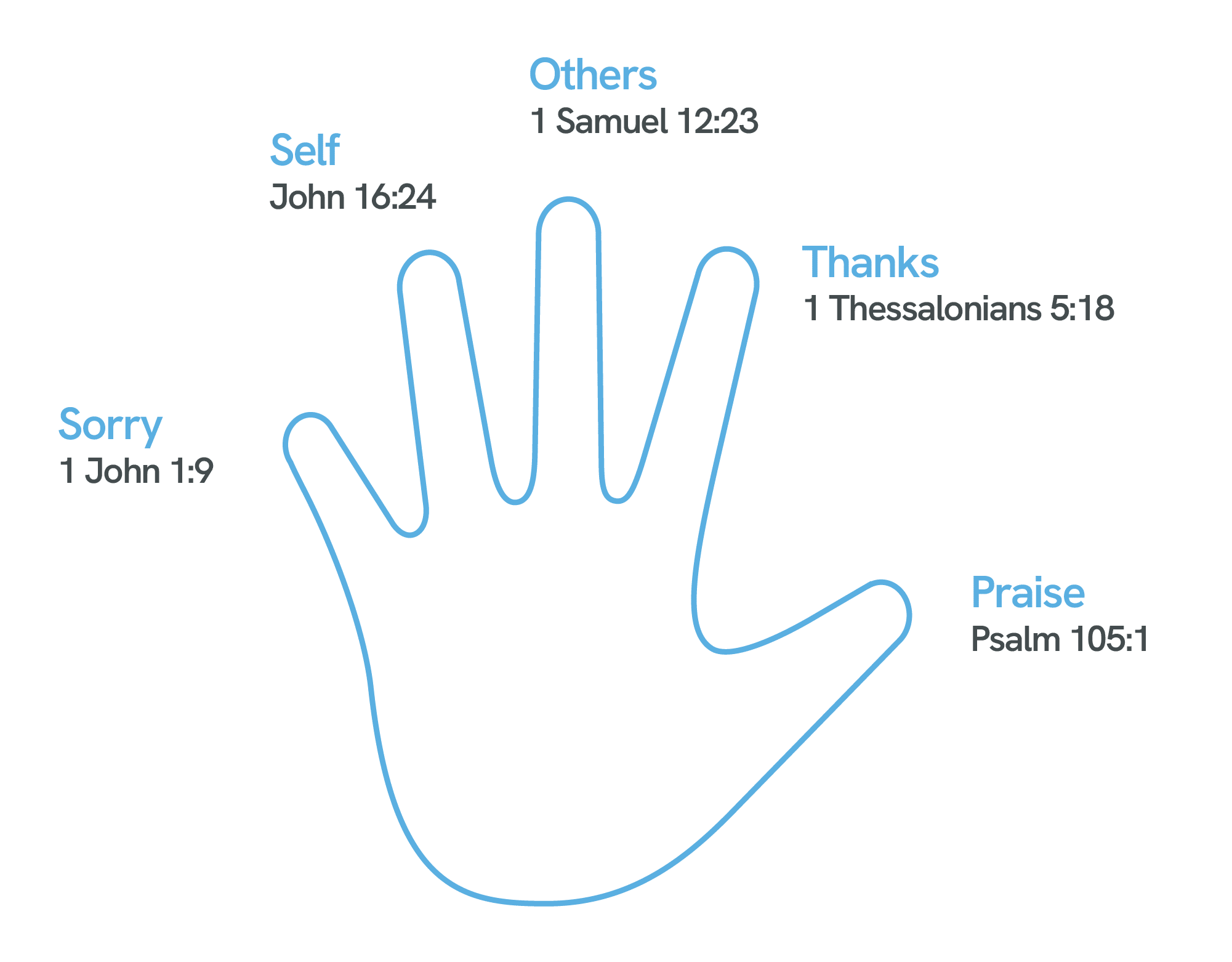
The Prayer Hand is an easy way to remember five key aspects of prayer: praise, saying sorry and thanks, and praying for others and self. Use this helpful diagram in your personal prayer life or when teaching about prayer to others.
Prayer is communicating with God as part of your relationship with him. You can talk to him as your caring Father and you can tell him your needs, joys and concerns. You can do it anyway you like: quietly in your heart, or out loud, or even by writing it down in a notebook or journal.
Praise
In the Lord’s Prayer Jesus showed what it means to praise God. He prayed, ‘Our Father in heaven, hallowed be your name’ (Matthew 6:9). Jesus wants us to remember how wonderful God is and for us to tell him. Psalm 105:1 says, ‘Give praise to the Lord, proclaim his name; make known among the nations what he has done.’ Another helpful verse about praise is Psalm 113:3.
Think of the ways in which you have experienced how wonderful God is. In Psalm 31:21-22, King David was able to praise God even in challenging times. Why do you think it is so important to tell God how much we appreciate him? What does it do for our own hearts?
Thanks
In the Lord’s Prayer Jesus prayed, ‘Your kingdom come, your will be done, on earth as it is in heaven’ (Matthew 6:10). As the Apostle Paul reminds us in 1 Thessalonians 5:18, God’s will for us involves being thankful: ‘Give thanks in all circumstances; for this is God’s will for you in Christ Jesus.’ God is in control of everything. He will always be, and no one can intimidate him or stop him. We can thank him for who he is and what he does. Another helpful verse is Ephesians 5:20.
Have you experienced something good in your life? Or in the lives of others? Take time to thank God. Also, thank him for who you are – he made you without any mistakes. Why do you think God wants thankfulness to be a part of our lives?
Others
You don’t have to feel unsure about praying for others. Samuel, a prophet and teacher in the Bible, told a crowd of people, ‘As for me, far be it from me that I should sin against the Lord by failing to pray for you’ (1 Samuel 12:23). Samuel knew the importance of praying for others. Other helpful verses are Colossians 1:9 and Ephesians 1:17.
Do you need wisdom in how to pray for others? What are their needs, desires and struggles? Look at the extra verses above; how can the Holy Spirit help you in your prayers for other people?
Self
God wants you to be bold in your prayers. Jesus said something amazing about prayer: ‘Until now you have not asked for anything in my name. Ask and you will receive, and your joy will be complete’ (John 16:24). Another helpful verse is 1 John 5:14-15. This applies not only when we pray for others; God also wants us to pray for ourselves. A relationship involves asking and receiving.
There will be some prayers that we see God act on immediately, whereas for some prayers it may might take a while before we see the answer. There are some prayers that God won’t act on, but even that is an answer. He loves you and knows what is best for you. Think of your needs, desires and struggles, and be bold as you pray for yourself.
Sorry
God wants you to be honest. Sometimes your sins might be embarrassing, and you might want to hide them from God, from others, and even from yourself. The Bible says this isn’t a wise thing to do: ‘If we claim to be without sin, we deceive ourselves and the truth is not in us’ (1 John 1:8). In the end, you are only fooling yourself.
Why is it important to be honest about who you are inside? How could pretending to be perfect affect the way we receive forgiveness from God? What would help you be honest before God?
Further Resources
Headliners
The key discipleship resources you need to start your journey.
Discipleship Weekly & Articles
An alongsider story or article to inspire you each week, delivered straight to your inbox.
Bookshop
All our recommended discipleship reading in one place.