
AI as a pseudo-alongsider
Bruno Trentini | 5 minute read
Prefer listening?
Bruno works as a Research Scientist in one of the top AI firms and is doing a PhD in AI.
Whether welcome or resisted, artificial intelligence (AI) is reshaping society. With the anxiety and excitement this brings, the use of AI is becoming ubiquitous, not only in professional and academic contexts but also in the sphere of spirituality.
In the Catholic context, the Deus in Machina project created an ‘AI Jesus’ confessional in Lucerne, Switzerland, and the post-experience survey found that two-thirds of participants reported having a ‘spiritual’ or thought-provoking experience (Lucerne University of Applied Sciences and Arts, 2024). Applications for spiritual counselling via chatbots have already reached tens of millions worldwide and the ChatGPT platform has a customised AI described as ‘A Baptist preacher’ that offers motivational, biblical sermons and guidance.
The reality of this begs the question of what place should AI have as we seek to get alongside people and make disciples. Here are 3 areas of disciple-making where we need to be aware of AI and its potential impact.
Relationship vs transactions
The eternal God does not call us to seek out oracles, but to live in relationship with him.
The main objective of AI systems is the optimisation of a statistical loss function (they are designed to learn by reducing the number of mistakes they make). Modern language models like Gemini or ChatGPT are capable of performing automated structured reasoning. If our relationships with friends, family and spouses were entirely formalised, completely structured and merely transactional, something would be gravely amiss, so why would that be different with God’s Holy Spirit?
When Jesus promises his disciples the coming of the Holy Spirit, he reveals interesting nuances:
‘But the Advocate, the Holy Spirit, whom the Father will send in my name, will teach you all things...’ (John 14:26 NIV)
Here the word ‘Advocate’ can also be translated as ‘Comforter’. Indeed, the original text in Greek gives us the term paraklétos (or paraclete), which means ‘the One who comforts’, ‘Counsellor’, ‘Advocate’, or ‘the One who is called alongside’ (the term ‘Alongsider’ is inspired by verses like this). These are not simply functional roles or fancy features, but personal attributes of a Spirit that desires to relate to us and instruct us. A little later Jesus says:
‘But when he, the Spirit of truth, comes, he will guide you into all the truth…’ (John 16:13 NIV)
A.W. Tozer reminds us that the Holy Spirit is not an impersonal energy or a vague, ethereal force, but a divine Person–holy and purposeful – who can be known, who loves, who speaks and chooses, who can be resisted and grieved (John 14:16-17, Isaiah 63:10), and who forms in us a renewed heart that prepares us to love and follow Jesus (Ephesians 3:16-17).
When a typed prompt replaces a wise friend or trusted alongsider, the pastor or priest, and especially the practices of silence and prayer before God, this consultation can become a habit – and habit quietly trains the conscience, either towards clarity or towards dullness.
Through AI tools and the speed at which we can access ‘answers’ to our questions, we could be at risk of relying on a pseudo-paraclete, a fake comforter, built in our own image, instead of relating to the Spirit of God himself.

Grace (1918–1920); by Eric Enstrom (1876–1968).
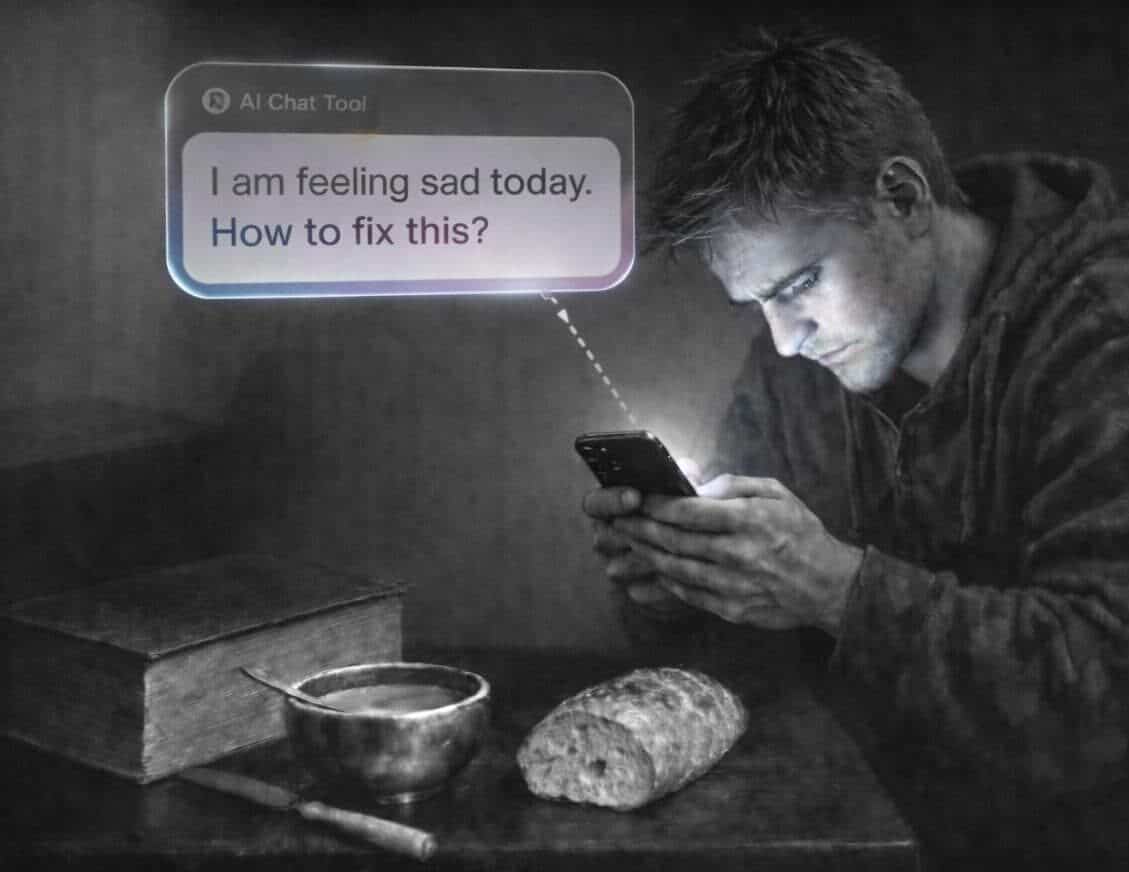
Pseudo-Paraclete (AI Generated)
Wisdom vs knowledge
What once depended on hard-to-find books and biblical reference works moved, in time, to search tools such as Google, then to applications like the Blue Letter Bible and Logos, and now to AI. We certainly have access to far more content and will be able to prepare Bible studies and sermons much faster. There is nothing problematic about using AI for deeper research, for recovering historical context, for comparing translations and for drawing connections between passages in the Old and New Testaments.
Yet, can it replace the wisdom that the Holy Spirit reveals? I have seen friends fact checking what the pastor says on ChatGPT or getting distracted by ‘going into more depth’ during the service.
Wisdom regarded as divine is not just information; it involves character, reverence for God and discipline of the heart. Proverbs 9:10 says, ‘The fear of the LORD is the beginning of wisdom’ (NIV).
We must also be aware that AIs are not perfect and can suffer with what in technical terms is called ‘hallucination’. They can invent things that are pure nonsense, misleading or wrong.
An AI model can produce correct rhetoric and yet push the heart toward the idolatry of ‘seems true’ because it ‘sounds intelligent’. The temptation is simple: to outsource moral judgment to something that assumes no guilt, asks for no forgiveness, and suffers no consequences.
Whilst the church can – and should – use AI as a tool for revealing more of God’s glory and to increase in knowledge, we must remember that an AI system is not concerned about building up the Church and the Kingdom of Heaven. It is not interested in the unique nuances and hidden treasures that God himself wants to reveal to us so that we too can grasp how wide and long and high and deep is the love of Christ (Ephesians 3:18).
We see this more clearly worked out in practice through preaching. John Piper, in his article ‘Should I Use AI to Help Me Write Sermons?’ (Desiring God, 2023), uses Matthew 15:8 and Isaiah 29:3 to draw an achingly sad picture: ‘These people honour me with their lips, but their hearts are far from me.’ (Matthew 15:8 NIVUK). Charles Spurgeon, in his book The Soul-Winner (William B. Eerdmans Publishing Co, 1959, p. 319) emphasises the power of the Holy Spirit at work in believers as they disciple others. Preaching, according to him, isn’t about rhetoric or argument, but the power of God changing hearts.
Discernment vs fear
We are witnessing a new industrial revolution and there is a clear divide between those who foresee social catastrophe through deepfakes, social control and intelligent-warfare, and those who anticipate a new wave of productivity and scientific breakthroughs in cancer research, energy production and crop improvements.
Even so, the answer is not to behave like the Church of Latter-day Luddites, going around smashing AI servers... A more constructive path is to receive this new technology with discernment and use it wisely.
God encourages his people to look at their context not with naïve optimism but with confidence in his provision. Even in the midst of Babylonian exile, the Israelites were called to live in accordance with God’s purposes, virtues and commands (Jeremiah 29:5-7).
The Holy Spirit is the ultimate paraclete and we need him alongside us. He gives us others too, so that we can walk this path with him together. As ‘a chosen people, a royal priesthood’ (1 Peter 2:9 NIV), we can help each other to sincerely pursue a way of using AI to love God above all things and to love one another as ourselves.
Related Posts

Fruit in Action: Faithfulness
Siku Kasongo, who serves with Navigators Zambia, tells an alongsider story that shows why faithfulness is less about perfection and more about simply keeping on showing up.

Fruit in Action: Goodness
Phil Watson, author of the Change Ready discussion guide series, reflects on four practical expressions of goodness in action from Paul’s letter to the Philippians. This is part of our series on the fruit of the Spirit (featuring artwork by Daniel White).

Fruit in Action: Kindness
Ash Leighton Plom, an ordained minister specialising in chaplaincy, coaching and therapy, reflects on how kindness is an expression of God’s grace that enlarges our capacity to love others. This is part of our series on the fruit of the Spirit (featuring artwork by Daniel White).
Further Resources
Headliners
The key discipleship resources you need to start your journey.
Discipleship Weekly & Articles
An alongsider story or article to inspire you each week, delivered straight to your inbox.
Bookshop
All our recommended discipleship reading in one place.